Wednesday, 24 June 2015

All The Way Down (of Climbing Vans and Granite Slabs)


"Where you are now you can't even imagine what the bottom will be like...

Only after disaster can we be resurrected. It's only after you've lost everything that you're free to do anything..."

-Tyler Durden, Fight Club 

No, this isn't some tragic tale of the shit hitting the fan, but rather a celebration of my continuing descent (read: plummet) in the opposite direction to what is typically considered by society to be the "correct" path through life. I just thought that the above Fight Club quote seemed strangely appropriate from the perspective of those amongst society walking the "road most traveled".

So, what journey into climbing bumb(li)ness would be complete without a Van to live your life of psuedo-squalor in? Within a few weeks of returning from Tasmania (in March) I'd picked up a 2002 Mitsubishi Delica 4WD Van (3.0L V6 Petrol), a vehicle I'd been researching for a while as a prospective CragVan™.

Here she is in all her Soccer Mum glory!

THE CragVan™


First up, I needed to build a bed frame. 

My objective was to make just a single bed (so I could maximise the available free space for more gear), and to have it elevated enough that I could utilise the empty space beneath it. I also wanted to leave one of the "dicky seats" in the back in situ, so that I could take a 2nd passenger if necessary, and also have a conventional seat to use if bad weather trapped me in the CragVan™ for an extended period of time. 

The limitation to all of this was that the only existing mounting points I had to use were the ones previously used by the seats I'd removed, which -from the perspective of a bed frame- were not ideally positioned, and also were only on the floor. Thus, any frame I built needed to be structurally self-sufficient so that side-to-side and front-to-back movement didn't compromise its integrity.

Spot the crucial missing LEGO brick.
Inevitably, I recruited my Old Man to assist in this task. We took some measurements, drew up a few rough drawings and discussed strategy. We resolved to work with wood because -basically- we were both too inexperienced (read: incompetent) to work with steel or pre-fabricated components, and -though possibly more time consuming- it would probably be cheaper.

So, with the concept of this aforementioned bed firmly entrenched in our collected minds, I went off to the Grampians and Arapiles, and returned to find that my Old Man had drawn up a complete schematic in 46 "simple steps" to build this frame. You remember in LEGO kits how the assembly instructions would involve adding a few components in each step, eventually resulting in an awesome Ice Planet spaceship (inevitably with one crucial missing LEGO brick that you forgot to add in Step 12, which would doubtless result in explosive decompression if the ship ever actually managed to leave Earth's atmosphere)? That is exactly what my Old Man had drawn up!

So, with the construction plans signed off. We purchased the materials and set to work (cue an A-Team-style montage music track):

Visualising the layout... It might've been easier just to leave it at this.
Step 1 in the Old Man's 46 "Simple Steps" to Success. The side-wall frame to start the ball rolling.
Is it a train? Is it a Billy Kart? No, but it IS starting to look a BIT like a bed frame.

The 85% assembled frame. The holes drilled in the bottom (and the obvious
bracket on the side are positioned to align with the 3 existing mounting points.


Fully assembled and ready for painting.
I figured that since we were doing this properly and not cutting any corners, I might as well paint and carpet it in order to make it more homely. It probably took us 3 full days of work to BUILD the frame, but it also took us another 3 full days of work to paint and carpet it:

After the 3rd layer of paint. Mmm... Invigoratingly Grey.
Gluing on the carpet. The wood and vices were to ensure that it bonded well in the
obvious "high stress" area. I found out the hard way that if you push TOO hard
on the carpet when the glue is still wet, it comes through the carpet and gets all
over everything.
Finished and ready for use!

So, with the frame finished, we wacked it in the back of the van. We then bought some foam, cut it to the appropriate size, re-sewed the mattress cover to the corresponding size, and voila! the CragVan™ Bed was complete.

But -aside from the many other minute modifications necessary to make a TRUE CragVan™, one thing was essential before it would be homely enough to live in: curtains! But alas, the frustrating shape of the Delica's window recesses meant that the conventional approach to van curtains wasn't quite as straightforward as it might appear. And so, after much debate (and many trips to Bunnings searching for inspiration), we decided on using the remaining Marine Carpet I'd purchased, cutting it into sections to fit each of the individual windows, and attaching it to the window with the help of velcro. Perhaps not the most aesthetic solution, but one that is cheap, effective, simple and "good enough".

As it turns out, my Old Man was apparently a seamstress in a past life, and masterfully sewed more than 40 velcro strips to the carpet, while I was relegated to cutting the carpet to the appropriate shape, and gluing the velcro to the windows (really, I'm surprised they even let me play with scissors).


The CragVan™ so far... Bed, Mattress, Sleeping Bag, Window "shutters", Esky, Stove... And a case of Boags. Awww yeah!
NOTE the velcro strips marking the "removed" window shutter. That one is cut in two separate halves so that I can leave my "blind spot" uncovered without having to take the entire "shutter" down.


And so, with the last MAJOR hurdle completed. It was time to take the CragVan™ out for a field test...


CANBERRA GRANITE (BOOROOMBA ROCKS):


On Sunday 21st June, Stephen Varney and I decided to head down to Booroomba Rocks to tackle some Canberra granite to practice for our upcoming trip to Yosemite (and to see if we could survive 3.5 days without killing each other... probably a good thing to know before spending 5 weeks in close confinement Big Walling in Yosemite).

Ahhh, Granite... Pain, friction slabbing, ridiculous runouts, tiny wires trapped between crystals that may or may not shatter... How I've missed thee...

Stephen Seconding me on my "made up" Pitch.
Great position and exposure!
For the first day we hit up the North Buttress, and started the day with Fiasco, a 6-pitch 2-star 18. The climb was reasonably entertaining, but hardly mind blowing. After finishing Pitch 4, I decided that the upper pitches looked too easy, and decided to invent a 50-metre pitch (at about Grade 20, and moderately bold) following a series of flared, thin, incipient cracks that snaked along a blunt arete. It was great, technical, thin climbing and just bold enough to be exciting (I'd argue that it was better than any pitch I'd done on Fiasco), though I still have no idea what exactly it was I'd climbed (or if it even HAD been climbed before).

I ended up below the 2nd pitch of Yellow Brick Road, and decided to continue up that. This pitch is particularly memorable because it has a single solitary bolt 1m off the belay, then an 7m runout through the hardest moves of the pitch before you get in some good gear behind a loose flake. Fortunately, the hardest moves are off the belay itself, and if you do fall during the runout (or, more likely, break something off) you're mostly just going to hurtle through the air and bounce off the slab below... provided your belayer manages to dodge you as you fly past.

We followed this adventure up with Incisor, a 3-star, 3-pitch trad 19. All 3 pitches on this one were unique and enjoyable in their own way. The first has some exciting and strenuous undercling and layback moves under, around and up past the "incisor" (a huge fang-shaped flake hanging steeply off the wall like a Sword of Damocles). The second (crux) pitch has a boulder-problem start, some technical thin crack climbing, some outrageous arete moves on nubs (and no protection), and a final traverse and fused-seam which I found highly technical. The final pitch involved some tenuous (and unprotected) moves up an enormous detached flake, which you then have to step across to gain a thin slab and perform a tricky mantle (still unprotected) before a simple ramble to the top. All in all, a great climb.
 

This is what a granite Mega-Classic looks like. Me Onsighting Integral Crack (20)
On Tuesday we went to the South Buttress, and I warmed up on the "must do" climb at Booroomba: Integral Crack (20). Often, a Super-Duper-Hyper-Mega-Mega-Classic doesn't tend to live up to its reputation, but this one did not disappoint. Aside from being a soaring, aesthetically beautiful line, the climbing is varied, challenging, a touch runout, and not at all what I expected. For every finger-lock you do, there are some thin face moves, a tips-layback, and funkiness up token granite flakes. There is tonnes of gear on it, but on each of the hard(er) sections, the crack fuses (hence the reason it gets hard) and there's no more gear for a while... So you ultimately end up doing all the hardest moves above your gear. I scored the onsight, and can safely say that this is one of the best pitches at the grade I've ever done on Granite.

Stephen then got his thrutch on and headed up the Old-School Roy's Crack (14) (only an old-school, beard-stroking thrutch-fest could possibly be called "Roy's Crack"). After that, I decided to get on a climb described in the guide as "The Best 21 at Booroomba": African Walking Tree (21). The climb looks pretty average from the ground, and had the guide not advised me otherwise, I would probably have just kept right on walking. I'm bloody glad that I didn't. African Walking Tree is a stellar pitch, with some thin, powerful (bolt protected) face-climbing to start, then a tricky and varied friction slab with spaced gear, culminating in an awesome corner-ramp-thing with bizarre and unique moves all the way to the anchor. I managed to forget to take many runners, so had to settle for placing very little gear on the entire 30m pitch, but that only added to the excitement.
 
Stephen styling "Anything So Nothing" P1 (20)
on Second.
For our final day, we went to the Central Slabs (near the North Buttress) with the goal of climbing Anything So Nothing, a 4-pitch 23 friction slab following a series of eye-catching water-streaks that run the length of the wall (and reminded me of Eurobin Falls at Mt Buffalo). From the ground it was obvious that much of the route was wet (the water streak was actually a water streak), but I was keen to give it a go, and jumped on the first pitch (which goes at gr20). In typical "old school granite friction slab" style, the pitch was quite run-out (especially at the start, climbing above some pretty average gear) but follows an obvious series of features/weaknesses, and so doesn't succumb to the "tedium" that many friction slabs suffer from. After risking life and limb, and battling right to the top of the pitch trying to avoid using half of the crucial holds (which were under the wet streak), I broke off a small crystal handhold I was using, and whipped onto the only bolt on the pitch: an old bash-in mild-steel carrot which I'd "clipped" with a wire. Dammit! Stephen styled the pitch on Second, and upon arriving at the belay it was obvious we wouldn't be continuing up this route... the upper pitches were proper wet.

Instead, Stephen headed up Jetts Sett P3 (18) which was conveniently next to the belay we were already on, and -in itself- was a funky steep layback crack-system with a few off-width sections to stem around. At this point the rain was moving in, but by the time I joined Stephen on the belay it had diminished enough that I was psyched for just oooooooone more pitch of climbing, and set off up High as Kites (20).


Well, every good trip needs a good epic, and this route was mine. It's first bolt is at about 10m, with some possible side-runners (if you start up the correct crack on the right), but no viable gear if you climb direct from the belay we were on (the belay below Fiasco P5). After clipping the bolt, hard-ish, runout friction slabbing ensues, with a particularly committing move left to gain a good seam (and a nice 0.3 cam placement) when your feet are about 6m above the bolt. I didn't want to commit to the move without SOME protection, and ended up standing on smeared feet, crimping a single miniscule sidepull for at least 20 minutes while I struggled to come up with SOME protection, and struggled to convince myself to do the move (since I really didn't have a choice). Predictably, while standing in this slippery stance for 20 minutes, the weather gods opted to smite me further, and it started raining. Granite Friction Slab + Rain = Awesome.

Here is the bit of gear I came up with to protect a 12m+ fall:


Psychological gear placement only, right?

Eventually I committed to the move, didn't fall off and die (unless this is some weird quasi-existential Sunset Boulevard blog update), got a good 0.3 cam placement, clipped one more bolt, and managed to find 2 more bits of gear to protect the remaining 20m of friction slab climbing (which -though not AS hard- still were far from easy). Stephen seconded me on it, and put in the good fight to get it clean as well.

Looking down at Stephen Seconding me on High as Kites (20). The 1st bolt is just below his feet, and the next bit of gear you can see quite some way above him is my "wonderful" wire placement. Exciting!

So, what to say about a climb like this? Perhaps the same thing as I would say about Booroomba Rocks as a climbing destination:

I enjoyed it in a somewhat masochistic, "great in hindsight", "probably not for everyone" kind of way. There are great climbs and great epics to be had here, but the price is a bit of effort, a willingness to adopt a slightly-bold mentality, and get a bit "old school". Booroomba has a staunchly old-school ethic which seems to involve next-to-no retrobolting, many tricky gear placements, bold climbing, and the various new(er) routes there tend to conform fairly closely to this standard. If nothing else, it makes it unique in a grid-bolted world. 
 
Stephen and I didn't kill each other either (or at least, they haven't found his body yet to know otherwise), so I guess that we're full steam ahead for Yosemite in September-October. Thanks for an entertaining weekend, Stephen!


NEXT TIME ON: The Climbing Obscurist:


A few weeks ago I bolted two more lines out at the Medlow Bath rap-in, climb-out area "The Sporting Complex". Both are about 35m long single-pitches in the 24/25 range, and consist of involved, technical face climbing with much thinness over some amazingly attributed rock.

The line on the left is my Being and Nothingness Project, and starts up an easy slab to the main face. After this there is an intense reachy/crimpy crux to gain the face, then an easier section of face/corner climbing to below the main bulge. After this it follows the vibrant orange streak through sustained small edges and pocket pulling all the way to the anchor, to produce an intense finale with a surprising number of varied pocket moves.

The line on the right is the Leviathan Project. It starts up Smoko (23), then heads right at an obvious traverse line, which lands you right in the middle of sustained techno-crimping to a stance. Some easy climbing leads to the middle crux, which is thin and very body-position dependent as you move around a rooflet-flake and into more easier climbing. The money, however, on this route is the upper bulge, which takes the steepest part of the face and moves through some bizarre slippery pockets following two parallel streaks: one black, one orange. The moves through this upper section are outrageous, especially when you add the amount of climbing you've done to get there, and the exposure below you.


I'm heading out tomorrow to do a few laps on Top Rope Solo before trying for the FAs over the weekend. I'm seriously psyched for these two beauties.

Hopefully, for my NEXT update, I'll be able to share some photos/videos of the First Ascents of these lines (assuming I succeed).

Be safe out there.


Thursday, 4 June 2015

Gramps, Piles, Bungers, Gibs and The Blues.


Sounds like a series of diseases straight out of Africa, right?

Alright, so it's been over a month since last I updated this. Obvious excuses aside, I've been busy climbing (not necessarily climbing WELL, but undeniably climbing LOTS).

THE GRAMPS:


After my last update I headed down to Victoria, and spent my first week down there in The Grampians, battling dubious weather and even more dubious climbing partners (not doubting their abilities to climb or belay, but certainly questioning their sanity at times, as evidenced by the below picture).


Pictured here (clockwise from Top Left): Strong Jeff, SilverFox, Pommy, Bulldog, JengA, Mitch and The Cleaner (me)... Apparently these guys have REAL names, but I don't actually know them.


Me on the crux move of Pitch 2 of World Party (27)
Me flashing the astonishing Pitch 3 of World Party (24)
Despite the obvious hardships of being a full time climbing bumb(bly), I managed to tick Mr Joshua (25 - 2nd shot), The Invisible Fist of Professor Hiddich Smiddich (26 - 3rd shot, battling rain blowing onto the crux on previous attempts), Medusa (25 - flash) and all 3 pitches of World Party (21 - Onsight, 27 - 5th shot, 24 - Flash) on Taipan Wall.

The others had their own successes, in particular Pommy ticked Chasing the Shadow (27) at The Gallery; Strong Jeff ticked Serpentine (29), Monkey Puzzle (28), and Like a Koala In His Eucalyptus (29) to name a few; JengA ticked Super Mario Bros Direct (27) at The Tower, All 3 pitches of World Party, and Not Too Bad (28) on Spurt Wall.


THE PILES:


After the Posse Comitatus headed back home, Rob Medlicott and I headed over to Mount Arapiles for another week of climbing, and met up with some other friends (Zack-Attack, Dennis the Menace, Chris Simpson, and Evan Freame). The weather was -for lack of a better word- abysmal, and almost every time we got out the bouldering pads or racked up for a lead, the heavens would dump a deluge on us, and it would be a prompt retreat back to the car to re-dry our gear... again. Amongst this rubbish weather, I still managed a fair bit of climbing, of particular note I had successes on Orestes (23 - Onsight), Birdman of Alcatraz (23 - Flash), Strolling (23 - 2nd shot), and a few others. I also managed to do quite a fair bit of free soloing of the various multipitch routes less than gr14 (no small ask, despite the relatively easy grade... Arapiles packs in a LOT of climbing into a grade 10!); some bouldering; and some easier rambles with various climbing partners. Not a bad week, all in all.


Yes, Ladies, I am this awesome! (on a grade 20 climb).
Dennis loving the weather on an "Active Rest Day".
Me ticking Strolling (23) and trying not to think about the crucial gear placed behind the moving block.


BUNGERS:

Back home after that, with a brief diversion to The Rock (near Wagga Wagga) for an afternoon of climbing with Matt Brooks at The Rock, I returned to The Blueys for a few days before making my way down to Bungonia Gorge with JengA for 3 days of climbing.


An archive photo from a day of climbing at Bungonia with
Neil Monteith last year.

If you've never climbed at Bungonia (one of only a handful of limestone climbing areas in Australia, and certainly one of the most intimidating), it's not the sort of place to ever underestimate. Even after having done most of the major routes there now, I still descend the hellish Red Track to the base of the gorge with a sense of trepidation and dread, feeling timid and dwarfed by the 300m+ high limestone walls on either side. The climbing really STARTS at gr22 in this place, and it's usually run-out, mixed climbing with tricky route-finding (sometimes dirty, sometimes chossy) gr22 climbing.


Me setting of on Pitch 2 of Iron Curtain (22).

We were rained out of Bungonia on the Friday, but found an alternative in climbing at Wingello. Saturday, however, JengA and I hit up Asteroids, the longest climbing route up the main part of the Gorge in all of Bungonia. To climb Asteroids, after reaching the base of the gorge via the unforgiving "Red Track" (no small task in itself), you start up Iron Curtain (21, 22, 22, 19), a low-angle limestone slab with spaced bolts, the odd bit of gear, and very pronounced thin cruxes. I'd climbed this previously and had found it quite challenging last time. This time, despite being rather hungover (drinking 1 litre of red wine will do that, apparently), I felt completely solid and fairly cruised up it, hands fondling congealed air-particles masquerading as holds, and feet smearing on invisible footers.

You then link into Pitch 6 of Screaming Tribesman (Trad 23), which I'd also climbed before and found it utterly desperate at the time, but mind-blowing in it's steepness, exposure, and "exciting" gear. This time, starting up it, I became flustered at the first crucial pre-crux gear placement, and muffed the crux another move or two up, taking an exciting fall onto gear 140-odd metres above the ground. I landed back on the no-hands rest before the real climbing (about 6m up from the belay), and started climbing again, this
On the belay at the end of Iron Curtain P4, and before
starting up Screaming Tribesman P5 (23).
A rough topo I drew of the route, from Iron Curtain Pitch 3 to the
Asteroids Topout. I took this photo last year during yet ANOTHER Bungonia wash-out.
time cruising to the top and having no problems finding gear whatsoever. Damn, I really should have lowered back to the belay ledge so I could have scored the tick. It was quite disappointing to get flustered and make such a silly mistake, and I really don't know how it happened. Suffice to say that -in something of a rarity for me on this STYLE of climbing- I lost my head, and -subliminally, not overtly- I got scared.

After that, you join Asteroids proper, consisting of pitches graded 26, 16, 20, 24, 20, 23. JengA had a go at freeing the 26 pitch, but the moves off the ledge are kind of unpleasant, and utterly desperate. In the end he pulled up to the 2nd bolt (which is a nice, sustained gr25 to the top from there, following a radical steep line of tufas) and tried to go for the 25M1 send, finally taking a whip only a few metres from the top. Following him up, I also came to the conclusion that the opening moves are nails and torturous, but -more importantly- the rest of the pitch (climbing on link from the 2nd bolt) is impossibly sustained, pumpy, and exposed in a bizarre Verdon Gorge (France) meets Terradets (Spain) kind of way. Unfortunately, like so many of the routes at Bungonia, it was also a bit fragile/chossy, and rather dirty (this is due to a lack of climbing traffic, and also a fine "dust" that settles on much of the rock due to the nearby limestone quarry. Suffice to say, even aiding to the 2nd bolt, I still didn't manage it clean to the top, with the last "slab" moves on the grey limestone being particularly malevolent in their hold-less intensity.

Next up was a doddly vegetated traverse pitch, with a grand total of 2 bolts on the entire 30m pitch, with the crux coming in the form of a rather sketchy down-climb to gain the next belay. It was fine on lead (since you clip a bolt ABOVE the down-climb, you're essentially protected on top-rope for the moves), but when JengA came to 2nd the down-climb, unclipping the bolt meant doing the down-climb unprotected. In classic Multipitch jiggery-pokery style, the solution was to LEAVE the rope clipped through the last bolt (leaving a 'biner in situ, thankfully someone else had already done that), and down-climb on top-rope, then build an improvised belay at the base, untie, pull the rope and re-tie-in, before finishing the traverse pitch.

JengA then lead the gr20 pitch, a very sustained pitch of varied climbing that ALMOST spat both of us off. Suffice to say, that for a face-and-slab pitch, it was sustained! Unerringly technical, and -in its sustainedness- rather intense. Getting up that clean, I then lead the 24 pitch, which was a great long pitch of slightly-steep face climbing on MOSTLY good rock (which unfortunately deteriorated towards the top). In classic ground-up, unchalked, unworn, on-sight style, I was on it for quite a while piecing together the lower and middle crux, before finally pumping out just after the middle crux and falling off. Disappointing, but it was a good battle, and the upper crux (which was rather sequency) MIGHT have spat me off anyway without the rest I received by taking the fall. JengA got it clean on 2nd. The bastard.

The next gr20 pitch was a doddle, and I failed to see how it got the grade. Finally I lead the last pitch of climbing, a whopping 50m pitch which tops out, then continues up a scrub bash to a safer "plateau" further up the hill. We knew that communication would be difficult on this pitch once I'd topped out, so we went with the "logical" system of non-communication belay change-over (as opposed to the "rope tugs" system, or whistles or any of the other more easily misinterpreted signals that it's safe for the person on Second to start to climb. This consists of the belayer taking me OFF-BELAY when only about 3m of rope remains between us (since, at that point, the belayer himself IS now the belay device), with the idea being that only after I'd built the belay, and set up the belay device to bring up the Second, would I take-in the remaining rope. At that point the former belayer counts to about 100, then climbs a move or two up to see if the rope is taken in. If it is, he dismantles the belay, and climbs up a bit further, all the while checking to verify that the rope keeps being taken in... Logically, at that point, one can deduce that -even without communication- he is on belay. I've used this system on at least 100 other multipitches, and (in reality) it can't be improved upon without bringing radios or whistles.

Here's where it FAILS, however.

The final pitch was mostly about grade 20 climbing, essentially being slightly-steep jugging on reasonable rock (only deteriorating right near the end of the pitch), but with a boulder-problem crux through a bulge near the top. Being rather worn-out at this point, the solution to the boulder-problem was to climb it in a Buoux-style pocket-sequence starting with my hands deliberately crossed up, so that they would unravel to reach the final crux holds in just the right order. Somehow it worked, and I Onsighted the pitch and began the gully-bash.

The description for this pitch says to belay off obvious trees, so I continued unprotected up the gully (I'd left my trad gear on the belay, and had run out of slings and quickdraws on the pitch), looking around for a viable belay tree, when I hear JengA shout out from below "off-belay!" It would seem that I'd gone beyond the "usual" belay point, and had now climbed 57m of my 50m pitch. It ALSO meant that I only had about 100 seconds before JengA would start testing to see if I was on belay (climbing a few moves, and waiting to see if I took in). In reality, the only thing that could go wrong here would be if JengA somehow managed to pull on the rope (falling, getting it caught in something, etc) with enough force to pull ME off, at which point (with no protection for about 20m of gully-bashing) I would be in for the catastrophic whip of my life. Still unable to find anything resembling a "belay tree", I opted for a collective mass of "emergency belay shrubs", and in about 20 seconds slung several shrubs using my prussiks and my own daisy chain. Within 1 minute I had my "anchor" built, and was on belay... Fortunately before JengA started climbing (it's worth pointing out, that even though we couldn't communicate, my army-trained voice managed to shout out "don't climb yet" enough for him to know to wait, when he first took me off-belay)

So, no harm no foul. Nothing went wrong, and in reality it was a relatively minor incident... but an interesting one to consider nevertheless. Also one that I'd never experienced before.

Arriving at the top with JengA after completing all 11-pitches of Asteroids. Check out my awesome belay shrub!

We topped out, hiked back to the car -arriving right on dark, for a 10-hour climb, car-to-car- and headed back to camp, utterly shattered with weariness. In that classic "overtired" mindstate, despite being starved I couldn't eat, and despite being desperately tired, I couldn't sleep. It was a strangely haphazard end to a mega-day of climbing.

For our last day in Bungonia, we hiked back down The Red Track and spent most of the day doing various single pitch routes of varying degrees of quality off the gorge floor. We ended the day by Jumaaring up an old fixed rope of Neil Monteith's to "Big Greenie" ledge above Palenta Pumper, in order to climb Attack of the Clones (25), quite possibly the BEST pitch of limestone in Australia, and capable even of standing up to other quality limestone routes in France and Spain.

Unfortunately, Neil's fixed rope put us one barely protected and rather sketchy traverse pitch away from where we wanted to be (soon rectified with some interesting climbing on marginal rock, and some creative "gear" placements... Thanks heaps Neil), but eventually I started up Attack of the Clones, going for the Onsight. Suffice to say I battled, but was stumped at half-height when I failed to see a "sneaky" hold that is rather crucial to the crux, and took another fall right at the final boulder-problem below the anchors. Disappointing, sure, but bloody oath is it ever a quality pitch: an awkward slab start leads to a Chimney/Stemming corner, then committing moves up slopers out right, then back left unlock a stunning series of linked clean tufas, with the hardest moves coming when one chandelier tufa ends, and you need to gain another one. Outrageous movements between "blobs" of hanging chandelier tufas (one of which you can sit on, legs spread either side like you're riding a horse), and funky solution pockets that arrive RIGHT when you need them, and not a moment too soon (or too late). Utterly, freaking, MEGA.

Naturally, JengA ticked it first shot today (he'd tried to onsight it about 3 years previously, but hadn't been on it since). The bastard. =P


THE GIB:

Me at the top after doing the First Ascent of Slow Gulpa (24).
The Pink Rope shows the line (the red rope is our rap rope).

A brief diversion down to Mount Gibraltar (near Mittagong) was necessitated by meeting with my prospective climbing partner for a trip to Yosemite in September - Stephen, from Wollongong. I've climbed at Mount Gibraltar quite extensively over the years, and ticked of pretty much everything there with stars attached to it. It's an interesting granite/trachyte crag, featuring many granite-style low-angle mixed routes, split by an imposing 40m high main face of beautifully featured and coloured rock consisting of mostly Trachyte (which is situated directly below Mount Jellore Lookout). Of particular note, it is host to the novelty route Big Bird (3-pitch 20); One of the best gr23 pitches in New Wouth Wales - Sluj Gulpa (3 pitches - 21, 22, 23), and a unique climb of two halves - Slow Twitch (Original - 20, Extension - 25), the extension being one of the most ridiculous stemming corners I've climbed in NSW, eerily reminiscent of Johnny Dawes' "The Quarryman" in Wales.

Aside from a new route put up by James Bultitude, which I was interested in doing the first CLEAN repeat of, I'd previously eyed off a linkup between the original Slow Twitch (20) into the top pitch of Sluj Gulpa (23, thereby avoiding the 2 "not as good" access pitches) via a 5m traverse (of NEW climbing) to make a giant single-pitch mega-route. To this effect I arrived early, rapped in, sussed the traverse moves to link the two climbs, and added an additional bolt to protect the traverse.

Stephen arrived, we determined through the course of the day that we get along well (climber-speak for: we probably won't murder each other after 4 days on a Big Wall in Yosemite) and I sandbagged him onto the various classics at The Gib. I managed to tick my mega-pitch linkup 2nd shot, for the First Ascent of Slow Gulpa (24), arguably the single best pitch of climbing at Mount Gibraltar. Featuring the weird friction slab start of Slow Twitch, and the steepening but juggy corner system near the end of that pitch, the rather bouldery hyper-technical gr24 traverse that I added, and the steep, technical thin-corner system on immaculate black rock that comprises Pitch 3 of Sluj Gulpa. All in all, I was pretty happy with the effort.

At the end of the day we climbed out via Modern Masculinity (14, 21, 19, 20), a predominantly trad route put up by James Bultitude. I'd led P1 previously, so Stephen had that pitch, then I linked Pitches 2 & 3 Onsight for a nice long pitch of very traddy trad climbing (read: a super-thrutchy and awkward crux) up a series of corners and through a final undercling roof-feature. After getting lost on the last pitch (we weren't too sure EXACTLY where it tackled the famous "beak" feature of The Gib), I got the final pitch clean as well. The last pitch, aside from being exposed, falls into the category of "weird", in that you are friction-slabbing on granules but trying to surmount an awkward overhang which comprises the beak feature. It seemed kind of desperate, yet when I did it RIGHT it was relatively easy. I really have no idea what grade it is.

All in all, a good day at Mount Gibraltar.


THE BLUEYS:


So, now for a few weeks back home before I head off... somewhere (exact destination still to be determined). Since I've been back I've done a bit of trad (Gemini (19), Solomon (2-pitch 20), played around on a few hard routes (Vanity Case (28), Whores Du Combat (28)) and done a bit of Sporty Sport climbing at Porters Pass and Shipley Upper.

I've also bolted 2 new lines out at The Sporting Complex at Medlow Bath, one of which tackles the orange-speckled face to the LEFT of the vegetated crack (a few metres left of Life of Riley) and should go at about 24/25 (tentatively called Being and Nothingness), and one which starts up Smoko to a traverse line at a few metres, hand traverses right to gain a dihedral, then heads up this and up the vibrant black streak that runs the length of the crag to the top, finishing between Smoko and Get a Black Dog Up Ya and will probably be about 24. This one is called Leviathan. I actually ran out of bolts to bolt the bottom part of Leviathan, so only the top half has rings and is tagged at the moment.

When I get back up the mountain, I need to finish bolting it and get those FA's done... Because I've got some suitably obscure TRADventures brewing at the back of mind, which I can't wait to sink my teeth into.

Tomorrow at 0600hrs I head down to Nowra for the long-weekend... the one climbing area I've ever climbed at in the entire world where the drop in the maximum grade I can red-point is actually quite substantial. We've managed to get together quite the posse, featuring Ben JengA, Mitch Perkins, Will Monks, Neil Monteith, Zack Swander, Kent Patterson, Jason "Pommy" Smith, Matt Brooks and maybe even Jason "Bundy" Lammers and Stephen Varney...

Huh... I guess I do know their names after all. Weird...

Thursday, 30 April 2015

The Obvious Elbow... OR How I Sent My "Magnum Opus" Project On The Last Day Possible Before Heading To The Grampians

Last time, on The Climbing Obscurist:
"When I climbed I Have a Dream (25) at Pierces Pass last year [...] I spotted a line which -to me at least- seemed to be more aesthetic than I Have a Dream, and possibly on better rock. [...] So, 2 weeks ago I finally decided to inspect this prospective golden line. [...] Fortunately, despite almost half a year of coveting this arbitrary piece of rock, it was as spectacular as I'd hoped. [...] I think another day or two or Top Rope Soloing it and I'll be ready to get on the sharp end. The first challenge, however, is to work out how to convince the weather gods to stop all the damned rain! [...] I've got another 1.5 weeks before I head down to the Grampians/Arapiles for 2 weeks, so hopefully I can get this beauty sent before I depart. Wish me luck!"

The Line of the Magnum Opus Project.

So, the rain finally stopped (briefly), and I headed out on Monday for a quick recon lap of the Project to see if it was actually dry enough to climb. The fact was that if it was still wet, then the Project would need to wait until after I got back from the Gramps, and possibly (depending on how quickly it gets cold up here in the mountains) until Spring. As luck would have it, it was bone dry. I did 3 more complete laps on Top Rope Solo, yet despite some excellent sections of linkage (including linking it in 2 overlapping sections) I never managed a complete link from start to finish. By the end of the day I was so tired that my trip to Penrith Climbing Centre to "train" became a social outing only.

After a rest day on Tuesday, and taking a chance that the forecast for crap weather wouldn't come into fruition, I headed back out on Wednesday with my Old Man -Glen- in tow once again, this time to see if I could scare myself into leading it successfully where Top Rope Soloing had failed.

The Gr3 access traverse from Lunch Ledge. Exposed!
After a warm-up on the top half of I Have a Dream (a really good way of getting prepped for a proper lap on I Have a Dream or my own Project), I rapped the line to equip it (20 quickdraws, and some looooooong runners essential) and Glen walked in via Lunch Ledge, and my bolted "grade 3" traverse.

After sketching out appropriately, shaking violently, and trying to crawl the entire length of the narrow "cave" system (seen in the photo to the left) rather than walk along the footledge, my Old Man declared that this particular experience had "crossed the line" of what he was willing to do to belay me. The fact is, that while he's done some multipitch before, and some fully-hanging belays, and climbed harder grades... Doing a balancy traverse above 200m of air is still bloody intimidating. It probably also might have helped if I'd swept the traverse free of rubble. Don't worry, I'll do it once I get back from the Gramps...


Doubting my ability to lead this Monster.

I tied in for the lead, and tore up it like a Man Possessed, cruising the first difficult section (about 6m 23), smashing out the pre-crux crux (5m 24), and making it to the last move of the crux still feeling quite good. The final move is a desperate deadpoint to a slippery 2-pad flat hold, which I've fallen off before when trying to link from the belay in the past. For whatever reason I didn't hold the move and took a 9m flight through the air past 4 draws. I was so busy swearing for having failed to stick the move that I didn't even have time to contemplate the fall itself, nor the hundreds of metres of air below me. Lowering back to the ledge, I had my doubts that I could link the route today, feeling that perhaps my power-endurance wasn't quite good enough to maintain such a high degree of intensity for such a long time... and I hadn't even started on the pumpy traverse (which comes immediately after the crux) and the committing hyper-crimps after it.

After a rest and some food, there was enough time (and energy) for 1 more shot. The initial section of climbing is about grade 15, up a 2 small overhanging corner-systems with ledge-breaks in between.

The "Pre-crux" crux... Grade 24 crimping.
Once you mantle onto the 2nd ledge (via an awkward undercling move) you go straight into reachy steep face climbing on pretty good holds which culminates in arriving on a big slippery flat hold. This section is about Gr23.

When you leave this flat hold, you enter the "pre-crux" crux, consisting of a difficult match on a small sidepull, a crimp, then a serious of rather tricky crimps on twin side-pull flakes. I usually regard this section as about Gr24, and it is probably the hardest ACTUAL climbing on the pitch.


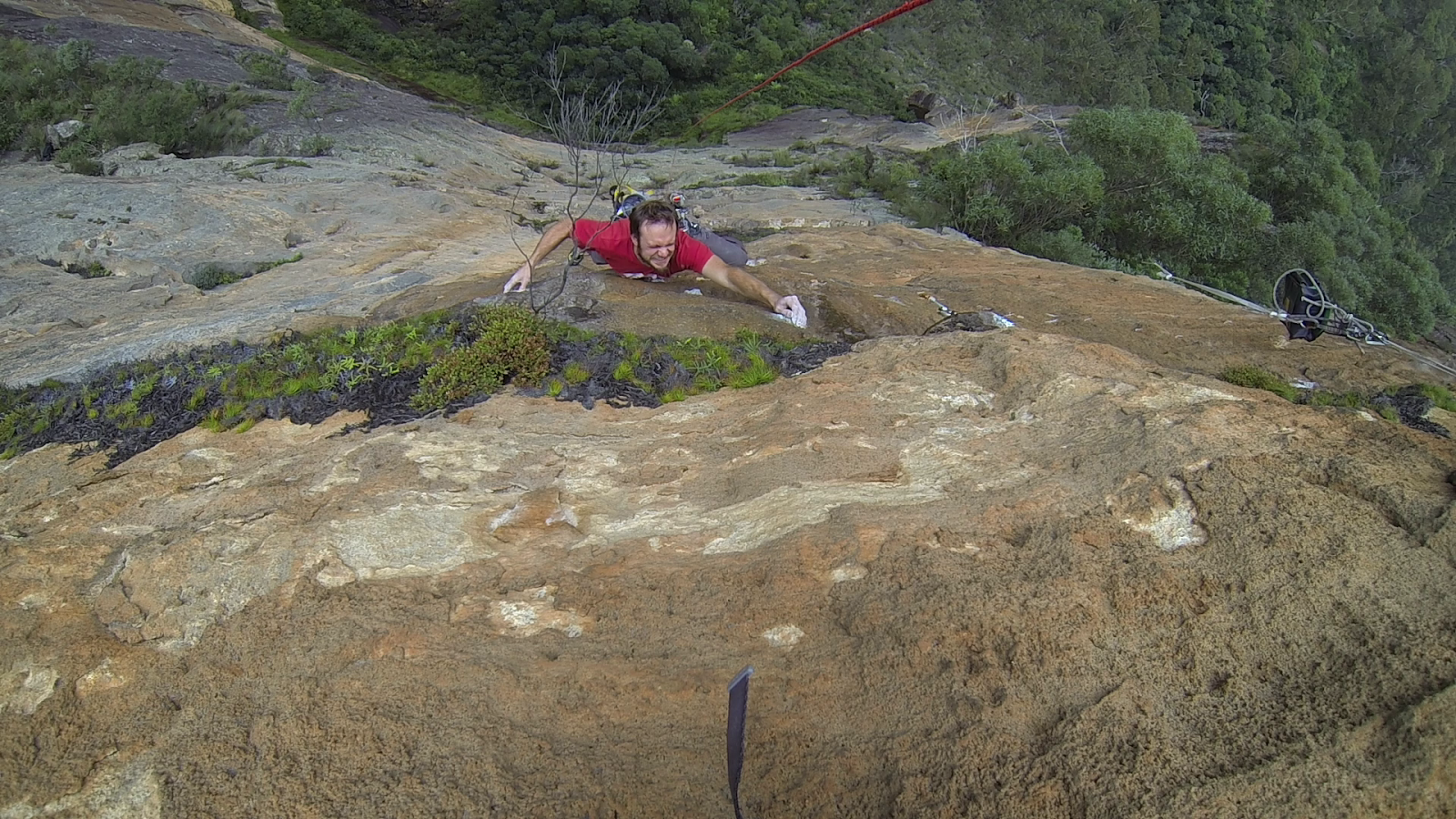
The penultimate move of the Grade 25 crux. Next move: the slippery throw.
From here you have another slippery flatty to clip from and take a few deep breaths, then you go into the crux proper. It's about 4m of actual movement, up super-thin water-polished sloping crimps which are quite a fair way apart. At one point even I use a mono-finger-stack in a shallow slippery pocket as a crucial hold! All of this culminates in a long reach to a hideously small sloping crimp, some crucial tic-tac footwork, and the lunge to the slippery flat hold that I'd fallen off on my previous shot. I usually regard this sequence as about Gr25 (soft-ish), particularly due to the slippery, sloping nature of the holds. 

A photo of the traverse, just after I bolted it. Gripping!
Half-anticipating another whipper, I managed to hold the throw, and -shaking as the adrenaline of what I perceived as an imminent fall wore off,- I upped my focus to make the pumpy traverse left. The traverse itself isn't too hard, just long reaches between good holds, but the feet are utterly terrible and it's crucial that you don't slip on the dots masquerading as footers. Due to the dog-leg, the traverse is also strategically bolted to minimise rope-drag, hence it's a bit gripping (especially when you're pumped). At the end of the traverse is an okay handjam (though you're still on your arms, so rest is minimal), at which point you slap up the arete to get your feet above the rooflet, and trend up-and-right back to the centre of the face via one last hard sequence of tiny crimps with big reaches in-between, and rubbish footers. On my best link from the belay on Top Rope Solo previously I'd fallen off on these crimps, pumped utterly senseless. This time, I made it through and arrived at the "balancy" no-hands rest point at about 3/5ths of the total climb height.

As I camped out on the no-hands rest, trying to recover for the remaining climbing (about 20 metres of pumpy Gr22ish climbing, with one tricky 23/24 move right near the top) I felt it beginning to rain. Apparently the forecast storms had decided to arrive right at that moment. Wearily I continued on, fighting the pump and trying to stay focused. I made it to the top crux of I Have a Dream and passed it surprisingly easily, but only 1 bolt from the top I started battling with the rope drag (which wasn't too bad, really) and managed to completely forget how to do the final moves. After a minor crisis of footwork ("Where did all the bloody footers go?") I mantled out over the top of the cliff to the ecstatic audience of a single goat investigating the gear I'd stashed there, and licking moss off a rock. Strangely my victory cheer didn't seem to bother the goat at all.
The view from the topout. Spectacular!

My ecstatic audience... once the crowd departed to the other side of the cliff.


So, the Magnum Opus Project was completed, and finally I could reveal it's real name: The Obvious Elbow of Aristocrat Arthur Decanter (58m Gr26).

My reasoning is this:
  • It's a direct parody of The Invisible Fist of Professor Hiddich Smiddich right down to the word structure and rhyming.
  • The Invisible Fist (or Invisible Hand, according to Adam Smith) is a term used in Economic Theory in reference to the effects within the Economic Market. Likewise, in our "anti-1%" and "anti-capitalism" modern society, an "obvious elbow" of a higher class of individual (a 1%er, or an Aristocrat) could be construed to be a similar play on the dual meaning of the name.
  • And finally, the climbing line itself has a rather obvious dog-leg (or elbow, if you will) smack-bang in the middle of it.
So, as you might imagine, I'm pretty bloody stoked right now. Thanks muchly to Glen for enduring his abject terror long enough for me to achieve the send (he actually managed to fall off the traverse while traversing back to lunch ledge... good thing my bolts and ropes are good); Thanks to the weather for waiting until I was back at my car, before turning a "shower" into a torrential downpour that has lasted several days; and thanks to Satan for letting me sell my soul for this Send (I still think I got the better end of the bargain).

Here's a video I made after the FA, just showing two of the major crux sections with the help of my GoPro, my helmet, and some climbing tape.:


A quick addentum before I depart: During the day I managed to stop a minor fall onto a stick with the help of my right-eyeball, and by the end of the day the pain was so severe that I could no longer keep my eye open. A visit to a doctor and an Optometrist reveals I've managed to lacerate my right eye... No one can say that I don't suffer for my art!


I am thus transformed into the Pirate I always wanted to be. Yarg!


Tomorrow I head off to the Grampians. Catch you all when I get back.


Sunday, 19 April 2015

Magnum Opus

Alright, so I haven't posted anything for a few weeks. This is due to 2 reasons:
  1. The Blue Mountains clearly has the worst weather in all of Australia. In 1 month back home, I've had more rubbish rainy weather than in almost 2 months in Tasmania. Consequently, it's quite hard to get out and actually DO anything exciting.
  2. The Magnum Opus Project at Pierces Pass.
So, since Point 1 doesn't need any elaboration (just look at the BOM if you don't believe me) permit me to elaborate Point 2.

When I climbed I Have a Dream (25) at Pierces Pass last year (you know, the stunning shot of Vince Day on the cover of Simon Carter's 2010 Blue Mountains Climbing guidebook?), I replaced 2 manky bolts on it, and amidst all my swinging around on the rap rope I spotted a line which -to me at least- seemed to be more aesthetic than I Have a Dream, and possibly on better rock.

I've got your number Vince Day. (Me on I Have a Dream (25))
During my 4.5 months of travels, I coveted that line despite having never actually CLIMBED it to see if it goes. I took to telling the various climbers I came across in Tasmania and Mount Buffalo that it was my Magnum Opus line, because it was one of the best looking lines I've ever seen in the Blueys, on one of the most inspirational walls.

So, 2 weeks ago I finally decided to inspect this prospective golden line. I rapped it, put some dynabolts in place to redirect the rope, figured out where it would go, and did a lap on Top Rope Solo to make sure that it all went at a reasonable grade. Fortunately, despite almost half a year of coveting this arbitrary piece of rock, it was as spectacular as I'd hoped.

So, The Magnum Opus Project starts from about 10m below, and 8m left of I Have a Dream on an obvious ledge (rather than the full-hanging belay of I Have a Dream), which can be accessed either by abseiling in (about 55m) or traversing in from Lunch Ledge (past 4 bolts, see the green line on the picture below for reference). Consequently, it has easier access.
 
The Green line is The Magnum Opus Project, the red line is I Have a Dream.


The line itself climbs straight up the guts of the wall, following an amazing dark-brown flowstone streak, through a long crux section of about gr25, then does a short (but airy) traverse left to a desperate mantle, before continuing up the face to join I Have a Dream where it heads left to the middle of the face, and continuing up that line (through its top crux) to the top. All in all it's a 58m pitch of gr25/26 climbing, above 150m+ of air, with relatively easy access and a fairly cozy (albeit exposed) belay. Best of all, you don't have to bring your second up if they don't want to climb it.

I've since spent another day Top Rope Soloing it (for 3 more laps) and linked from the belay to the last move of the crux (falling off the final throw to a nice flat hold), though I still have a solid 9m of pumpy climbing before a proper rest. I think another day or two or Top Rope Soloing it and I'll be ready to get on the sharp end. The first challenge, however, is to work out how to convince the weather gods to stop all the damned rain!

At any rate, that's what's been keeping me busy in the interim. I've got another 1.5 weeks before I head down to the Grampians/Arapiles for 2 weeks, so hopefully I can get this beauty sent before I depart.

Wish me luck!


Where it starts getting hard. Bouldery 24 through thin flakes. Where the rope is attached to the wall is the belay. Steep ay?
The main crux. Hard 24/25 up flowstone rock, immediately after the previous crux. Hard work!

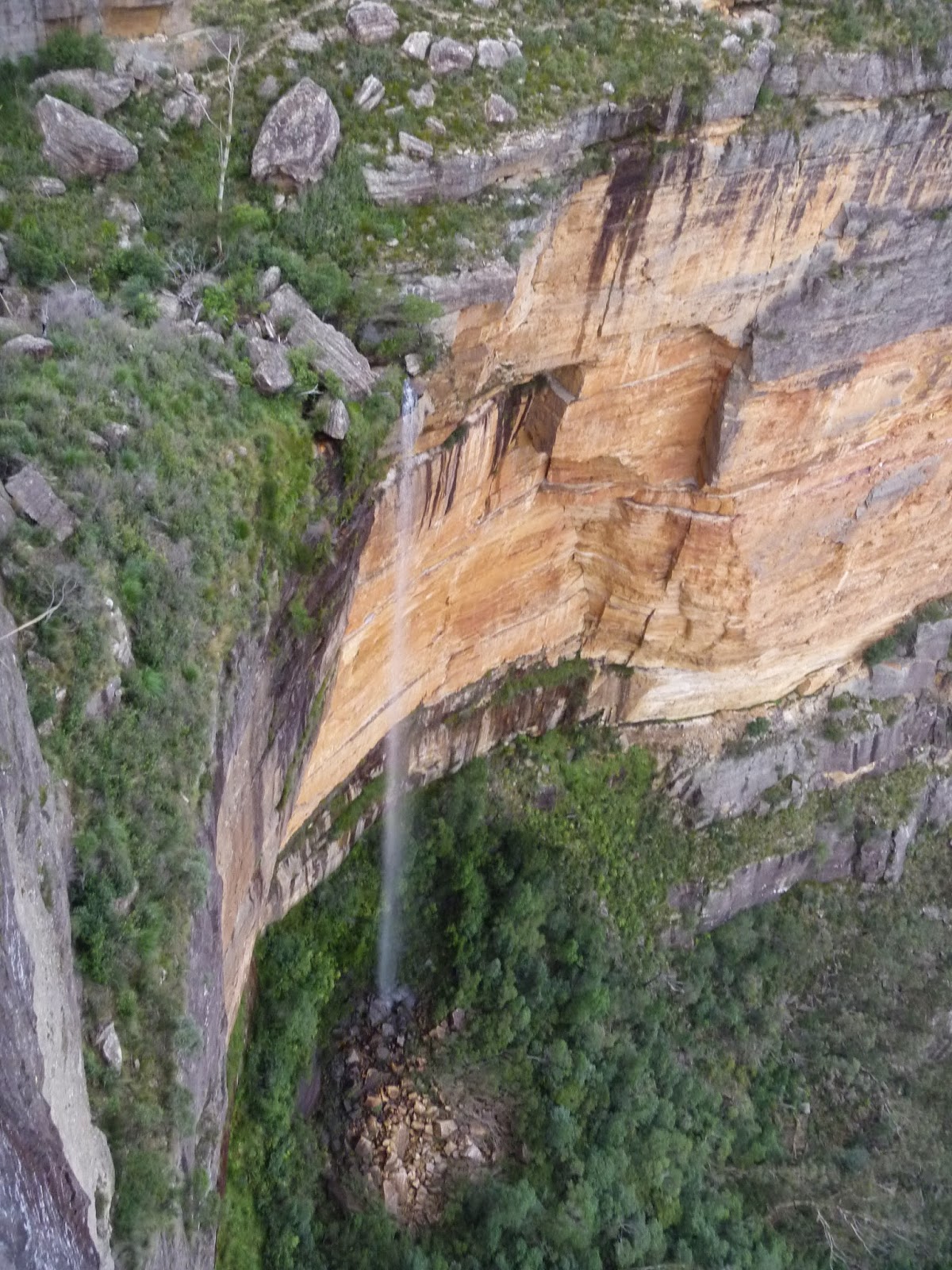
The traverse line immediately after the main crux, pumpy and airy 22. Flat holds below an overlap (beneath the vegetation) then a mantle, before heading back right after the top bolt you can see in the photo. The arete left of the bolt is Disco Non-Stop Party (25), and the one in the distance is Debris (23).
Looking down the entire face from just below the top-out of I Have a Dream. Exposed!

Thursday, 9 April 2015

Mythical Birds

Alright, so as my buddy Zack pointed out on TheCrag.com last week, The Phoenix, Archeopteryx, Quetzalcoatl and Жар-пти́ца (Zhar-ptitsa - The Firebird, in Russian folklore) aren't all actually mythical birds... But I like the title for this blog, so you guys will just have to forgive me this little bit of creative license.

So, after I tore my hamstring in 3 places (while Rock Climbing, naturally) back in 2012, I was unable to climb for months on end, and spent my recovery time pulling vegetation out of the Blue Mountains Classic Crack "The Phoenix (20)", and slashing a new access track from above (the original track was a 1-hour leach-infested slog to rival the Kokoda Trail). Here are some archived photos of my Before and After efforts for posterity:

Extreme Gardening!
Now a megaclassic!


Since I was also learning to bolt at this time, I also bolted 5 pitches worth of climbing in the vicinity. 3 of them I freed back in 2013 (Archeopteryx (2-pitch 21), and Quetzal (very bold 50m 21). But the Direct finish to Quetzal (tentatively called Quetzalcoatl) felt so desperate at the time that I was convinced that it was a solid gr24 powerslab and doubted of my ability to send it. I also never managed to convince a belayer to come back to belay me on the other 2-pitch line on the headwall above The Phoenix that I bolted: Жар-пти́ца (The Firebird).

Looking down at Gene Gill on Belay after doing the First Ascent of Archeopteryx (2-pitch 21).

Me on a repeat of The Phoenix (50m 20) back in 2013.
Gene attempting to repeat Quetzal (50m BOLD 21)


Now that I'm back home from Tasmania and on a crusade to clean up all of my old unsent bolted projects, I figured that it was about time to complete my unfinished business out at The Phoenix crag. Naturally, the poor individual that I cajoled into belaying me was my old man, Glen Thomson, (who seems to show a remarkable ability to remember his previous "Project Belaying" experiences with me via rose-tinted spectacles), and so it was that on 8th April 2015 we two went back into the jungle.

First up was Жар-пти́ца (The Firebird) (seriously, that's the route's name), which -to avoid the long traverse access pitch which I'd freed previously- we rapped into from the very top of the crag. The main pitch (pitch 2) traverses left across the overhanging headwall above The Phoenix, then climbs up the steep (but juggy) arete to the top of the cliff. In my picture of Gene on Quetzal above, that steep prow at the top of the photo is the line it climbs.

With the wind blowing directly on the headwall, and it snowing out at Oberon, it was proper arctic as I went for the send. But the climbing is quite easy, though somewhat runout, even with a few supplemental pieces of gear. And -as you will see from the photos below- the exposure is quite monolithic for an easy climb.

To the right is a panorama photo I took from halfway up the climb, looking down at my old-man on the semi-hanging (or sitting, if you're scared, right Glen?) belay at the start of Pitch 2 of Жар-пти́ца (The Firebird).
 
The line of Жар-пти́ца (The Firebird) heads up the "holey" arete.


It went first shot and I scored the First Ascent, choosing to give it gr19. As I said, it's quite easy, the position and exposure are radical, the climbing is good, and the bizarre arete feature is out there... But -to be honest- the rock quality on the "holey" section of the arete is pretty terrible. I don't mind admitting that I was a bit scared, but mostly of breaking something off and going for a fall into the void. Regardless, though, it's an awesome adventure, just not a great climb.


Next up was the Direct Finish to Quetzal, called Quetzalcoatl.The original line of Quetzal avoided the direct finish (because it is substantially harder) and traverses right a few metres to join The Phoenix at it's top crux, making an awesome 52m pitch of bold, mixed slabbing. Quetzalcoatl refuses to cop-out when the going gets hard, and forges straight up the slab as it approaches vertical via a line of congealed air particles masquerading as holds.

To get to it we rapped back to the belay above The Phoenix crack. I rapped in to the line itself (which climbs the steepening slab to the left of The Phoenix) and did a quick refresher lap on Top Rope Solo (and to tick up the crux holds, my chalk having been washed away by the torrential flood of the last few days). It went pretty easily, so my old man rapped in to join me on the fully-hanging belay, and I tied in for the First Ascent.

A quick Top Rope Solo lap on Quetzalcoatl.
Despite the "business end" being kind of short (about 12m, or so, with 40-odd metres of gr20ish slabbing on the lower pitch), the actual moves are pretty exciting. In particular, a high, square heel-toe-catch on the side of a tiny flake feature, which I then rock over, relying completely on the heel and the edge of my toe to keep me attached to the rock. It's also extremely thin and balancy, though -being a slab- it's possible to take your hands off after every few moves. Consequently, I really have no idea what grade it goes at. Back at the start of 2013 I was convinced it was solid 24 slab and it felt utterly desperate. When I did a few laps on Top Rope Solo last week, I thought it might be middle-tier (or a bit soft) 23. Yesterday, after doing the First Ascent of Quetzalcoatl, I decided to log it as a 22. Probably a sandbag, but it could be called 22 in the same vein as Chase the Lady at Centennial Glen, or Dragon Egg at Porters Pass (both are actually gr23, but constitute sandbagged slabs even at that grade).

Approaching the top of Quetzalcoatl, post-crux. Thin-as, bro!

The crazy square-heel-toe-catch-rockover move. Yeah, those are tic-tacs I'm crimping.
And so, with Quetzalcoatl (22) done, that's the last of my "bolted but unclimbed" lines in the Blue Mountains done and dusted... Well, all bar a certain linkup on Grasshopper Wall (tentatively named "Green Grocer"), but that thing is a proper cock-around to get to, and the crux holds are under the main waterstreak down that face, (in 3 separate trips to climb it I've only seen it dry once). I'm almost happy to call that one an "open project"... Except that I have another 2 projects at Pierces Pass (a bolted but unclimbed line offered to me by a friend, and my "magnum opus" line that I've scoped but not bolted), so as I'll be in the vicinity anyway... it might we worth a lap. 

I'll let you guys know in the next few days.

The Red Line is the "Green Grocer Linkup. Blue is Cicada (3-pitch 24), Green is Cricket (1 or 2 pitch 23).