Thursday, 30 April 2015

The Obvious Elbow... OR How I Sent My "Magnum Opus" Project On The Last Day Possible Before Heading To The Grampians

Last time, on The Climbing Obscurist:
"When I climbed I Have a Dream (25) at Pierces Pass last year [...] I spotted a line which -to me at least- seemed to be more aesthetic than I Have a Dream, and possibly on better rock. [...] So, 2 weeks ago I finally decided to inspect this prospective golden line. [...] Fortunately, despite almost half a year of coveting this arbitrary piece of rock, it was as spectacular as I'd hoped. [...] I think another day or two or Top Rope Soloing it and I'll be ready to get on the sharp end. The first challenge, however, is to work out how to convince the weather gods to stop all the damned rain! [...] I've got another 1.5 weeks before I head down to the Grampians/Arapiles for 2 weeks, so hopefully I can get this beauty sent before I depart. Wish me luck!"

The Line of the Magnum Opus Project.

So, the rain finally stopped (briefly), and I headed out on Monday for a quick recon lap of the Project to see if it was actually dry enough to climb. The fact was that if it was still wet, then the Project would need to wait until after I got back from the Gramps, and possibly (depending on how quickly it gets cold up here in the mountains) until Spring. As luck would have it, it was bone dry. I did 3 more complete laps on Top Rope Solo, yet despite some excellent sections of linkage (including linking it in 2 overlapping sections) I never managed a complete link from start to finish. By the end of the day I was so tired that my trip to Penrith Climbing Centre to "train" became a social outing only.

After a rest day on Tuesday, and taking a chance that the forecast for crap weather wouldn't come into fruition, I headed back out on Wednesday with my Old Man -Glen- in tow once again, this time to see if I could scare myself into leading it successfully where Top Rope Soloing had failed.

The Gr3 access traverse from Lunch Ledge. Exposed!
After a warm-up on the top half of I Have a Dream (a really good way of getting prepped for a proper lap on I Have a Dream or my own Project), I rapped the line to equip it (20 quickdraws, and some looooooong runners essential) and Glen walked in via Lunch Ledge, and my bolted "grade 3" traverse.

After sketching out appropriately, shaking violently, and trying to crawl the entire length of the narrow "cave" system (seen in the photo to the left) rather than walk along the footledge, my Old Man declared that this particular experience had "crossed the line" of what he was willing to do to belay me. The fact is, that while he's done some multipitch before, and some fully-hanging belays, and climbed harder grades... Doing a balancy traverse above 200m of air is still bloody intimidating. It probably also might have helped if I'd swept the traverse free of rubble. Don't worry, I'll do it once I get back from the Gramps...


Doubting my ability to lead this Monster.

I tied in for the lead, and tore up it like a Man Possessed, cruising the first difficult section (about 6m 23), smashing out the pre-crux crux (5m 24), and making it to the last move of the crux still feeling quite good. The final move is a desperate deadpoint to a slippery 2-pad flat hold, which I've fallen off before when trying to link from the belay in the past. For whatever reason I didn't hold the move and took a 9m flight through the air past 4 draws. I was so busy swearing for having failed to stick the move that I didn't even have time to contemplate the fall itself, nor the hundreds of metres of air below me. Lowering back to the ledge, I had my doubts that I could link the route today, feeling that perhaps my power-endurance wasn't quite good enough to maintain such a high degree of intensity for such a long time... and I hadn't even started on the pumpy traverse (which comes immediately after the crux) and the committing hyper-crimps after it.

After a rest and some food, there was enough time (and energy) for 1 more shot. The initial section of climbing is about grade 15, up a 2 small overhanging corner-systems with ledge-breaks in between.

The "Pre-crux" crux... Grade 24 crimping.
Once you mantle onto the 2nd ledge (via an awkward undercling move) you go straight into reachy steep face climbing on pretty good holds which culminates in arriving on a big slippery flat hold. This section is about Gr23.

When you leave this flat hold, you enter the "pre-crux" crux, consisting of a difficult match on a small sidepull, a crimp, then a serious of rather tricky crimps on twin side-pull flakes. I usually regard this section as about Gr24, and it is probably the hardest ACTUAL climbing on the pitch.
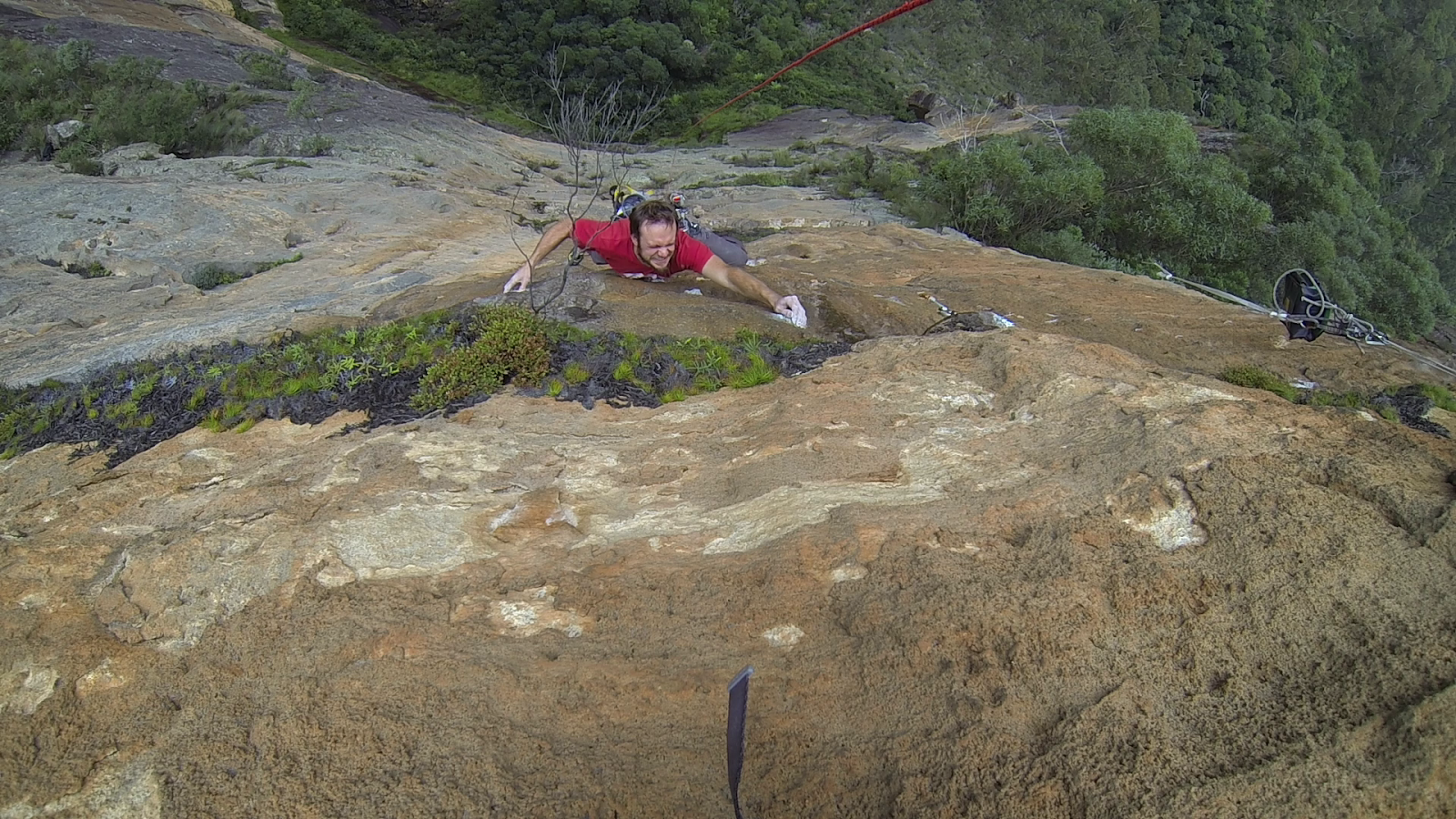

The penultimate move of the Grade 25 crux. Next move: the slippery throw.
From here you have another slippery flatty to clip from and take a few deep breaths, then you go into the crux proper. It's about 4m of actual movement, up super-thin water-polished sloping crimps which are quite a fair way apart. At one point even I use a mono-finger-stack in a shallow slippery pocket as a crucial hold! All of this culminates in a long reach to a hideously small sloping crimp, some crucial tic-tac footwork, and the lunge to the slippery flat hold that I'd fallen off on my previous shot. I usually regard this sequence as about Gr25 (soft-ish), particularly due to the slippery, sloping nature of the holds. 

A photo of the traverse, just after I bolted it. Gripping!
Half-anticipating another whipper, I managed to hold the throw, and -shaking as the adrenaline of what I perceived as an imminent fall wore off,- I upped my focus to make the pumpy traverse left. The traverse itself isn't too hard, just long reaches between good holds, but the feet are utterly terrible and it's crucial that you don't slip on the dots masquerading as footers. Due to the dog-leg, the traverse is also strategically bolted to minimise rope-drag, hence it's a bit gripping (especially when you're pumped). At the end of the traverse is an okay handjam (though you're still on your arms, so rest is minimal), at which point you slap up the arete to get your feet above the rooflet, and trend up-and-right back to the centre of the face via one last hard sequence of tiny crimps with big reaches in-between, and rubbish footers. On my best link from the belay on Top Rope Solo previously I'd fallen off on these crimps, pumped utterly senseless. This time, I made it through and arrived at the "balancy" no-hands rest point at about 3/5ths of the total climb height.

As I camped out on the no-hands rest, trying to recover for the remaining climbing (about 20 metres of pumpy Gr22ish climbing, with one tricky 23/24 move right near the top) I felt it beginning to rain. Apparently the forecast storms had decided to arrive right at that moment. Wearily I continued on, fighting the pump and trying to stay focused. I made it to the top crux of I Have a Dream and passed it surprisingly easily, but only 1 bolt from the top I started battling with the rope drag (which wasn't too bad, really) and managed to completely forget how to do the final moves. After a minor crisis of footwork ("Where did all the bloody footers go?") I mantled out over the top of the cliff to the ecstatic audience of a single goat investigating the gear I'd stashed there, and licking moss off a rock. Strangely my victory cheer didn't seem to bother the goat at all.
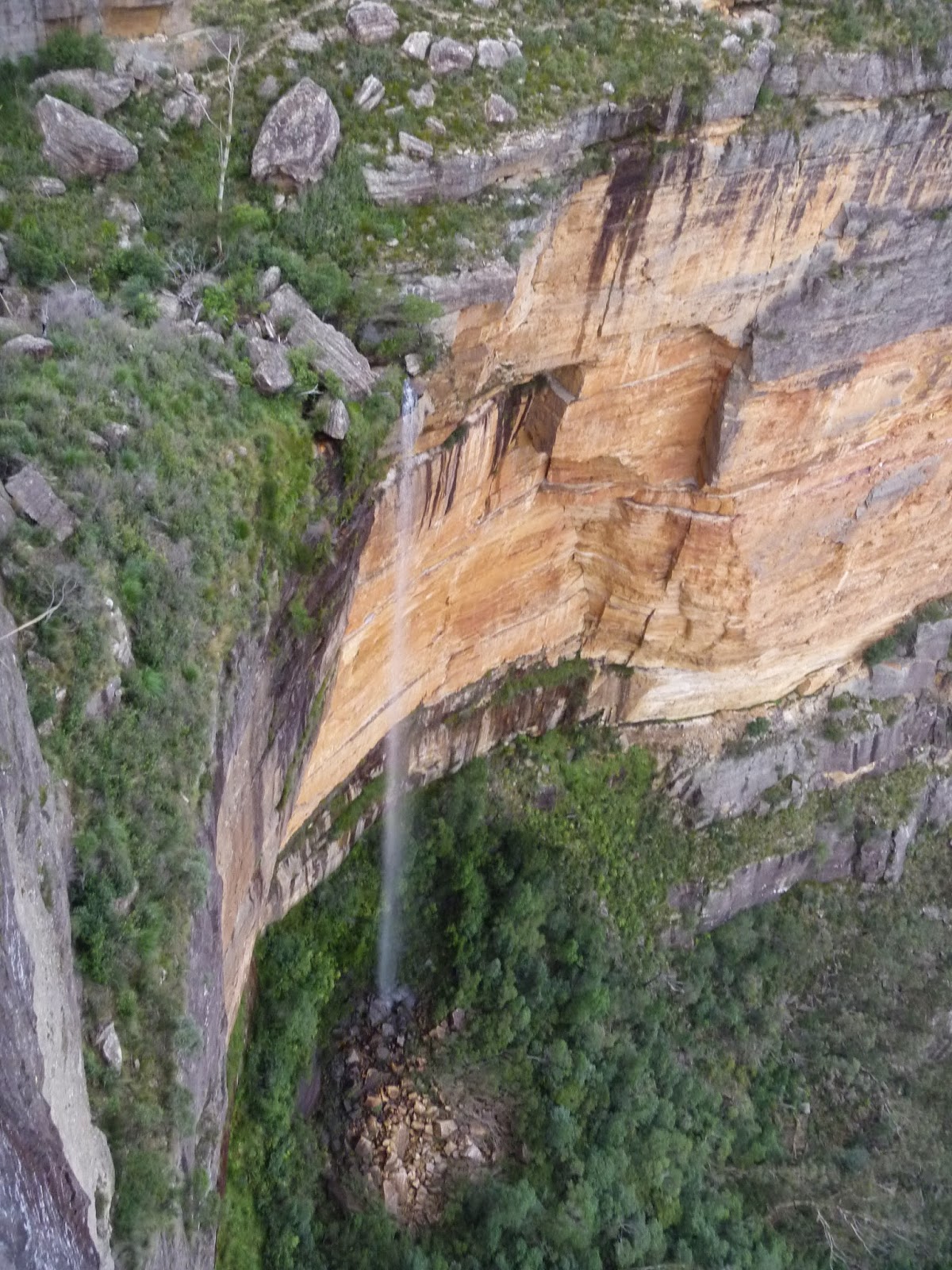
The view from the topout. Spectacular!

My ecstatic audience... once the crowd departed to the other side of the cliff.


So, the Magnum Opus Project was completed, and finally I could reveal it's real name: The Obvious Elbow of Aristocrat Arthur Decanter (58m Gr26).

My reasoning is this:
  • It's a direct parody of The Invisible Fist of Professor Hiddich Smiddich right down to the word structure and rhyming.
  • The Invisible Fist (or Invisible Hand, according to Adam Smith) is a term used in Economic Theory in reference to the effects within the Economic Market. Likewise, in our "anti-1%" and "anti-capitalism" modern society, an "obvious elbow" of a higher class of individual (a 1%er, or an Aristocrat) could be construed to be a similar play on the dual meaning of the name.
  • And finally, the climbing line itself has a rather obvious dog-leg (or elbow, if you will) smack-bang in the middle of it.
So, as you might imagine, I'm pretty bloody stoked right now. Thanks muchly to Glen for enduring his abject terror long enough for me to achieve the send (he actually managed to fall off the traverse while traversing back to lunch ledge... good thing my bolts and ropes are good); Thanks to the weather for waiting until I was back at my car, before turning a "shower" into a torrential downpour that has lasted several days; and thanks to Satan for letting me sell my soul for this Send (I still think I got the better end of the bargain).

Here's a video I made after the FA, just showing two of the major crux sections with the help of my GoPro, my helmet, and some climbing tape.:


A quick addentum before I depart: During the day I managed to stop a minor fall onto a stick with the help of my right-eyeball, and by the end of the day the pain was so severe that I could no longer keep my eye open. A visit to a doctor and an Optometrist reveals I've managed to lacerate my right eye... No one can say that I don't suffer for my art!


I am thus transformed into the Pirate I always wanted to be. Yarg!


Tomorrow I head off to the Grampians. Catch you all when I get back.


Sunday, 19 April 2015

Magnum Opus

Alright, so I haven't posted anything for a few weeks. This is due to 2 reasons:
  1. The Blue Mountains clearly has the worst weather in all of Australia. In 1 month back home, I've had more rubbish rainy weather than in almost 2 months in Tasmania. Consequently, it's quite hard to get out and actually DO anything exciting.
  2. The Magnum Opus Project at Pierces Pass.
So, since Point 1 doesn't need any elaboration (just look at the BOM if you don't believe me) permit me to elaborate Point 2.

When I climbed I Have a Dream (25) at Pierces Pass last year (you know, the stunning shot of Vince Day on the cover of Simon Carter's 2010 Blue Mountains Climbing guidebook?), I replaced 2 manky bolts on it, and amidst all my swinging around on the rap rope I spotted a line which -to me at least- seemed to be more aesthetic than I Have a Dream, and possibly on better rock.

I've got your number Vince Day. (Me on I Have a Dream (25))
During my 4.5 months of travels, I coveted that line despite having never actually CLIMBED it to see if it goes. I took to telling the various climbers I came across in Tasmania and Mount Buffalo that it was my Magnum Opus line, because it was one of the best looking lines I've ever seen in the Blueys, on one of the most inspirational walls.

So, 2 weeks ago I finally decided to inspect this prospective golden line. I rapped it, put some dynabolts in place to redirect the rope, figured out where it would go, and did a lap on Top Rope Solo to make sure that it all went at a reasonable grade. Fortunately, despite almost half a year of coveting this arbitrary piece of rock, it was as spectacular as I'd hoped.

So, The Magnum Opus Project starts from about 10m below, and 8m left of I Have a Dream on an obvious ledge (rather than the full-hanging belay of I Have a Dream), which can be accessed either by abseiling in (about 55m) or traversing in from Lunch Ledge (past 4 bolts, see the green line on the picture below for reference). Consequently, it has easier access.
 
The Green line is The Magnum Opus Project, the red line is I Have a Dream.


The line itself climbs straight up the guts of the wall, following an amazing dark-brown flowstone streak, through a long crux section of about gr25, then does a short (but airy) traverse left to a desperate mantle, before continuing up the face to join I Have a Dream where it heads left to the middle of the face, and continuing up that line (through its top crux) to the top. All in all it's a 58m pitch of gr25/26 climbing, above 150m+ of air, with relatively easy access and a fairly cozy (albeit exposed) belay. Best of all, you don't have to bring your second up if they don't want to climb it.

I've since spent another day Top Rope Soloing it (for 3 more laps) and linked from the belay to the last move of the crux (falling off the final throw to a nice flat hold), though I still have a solid 9m of pumpy climbing before a proper rest. I think another day or two or Top Rope Soloing it and I'll be ready to get on the sharp end. The first challenge, however, is to work out how to convince the weather gods to stop all the damned rain!

At any rate, that's what's been keeping me busy in the interim. I've got another 1.5 weeks before I head down to the Grampians/Arapiles for 2 weeks, so hopefully I can get this beauty sent before I depart.

Wish me luck!


Where it starts getting hard. Bouldery 24 through thin flakes. Where the rope is attached to the wall is the belay. Steep ay?
The main crux. Hard 24/25 up flowstone rock, immediately after the previous crux. Hard work!

The traverse line immediately after the main crux, pumpy and airy 22. Flat holds below an overlap (beneath the vegetation) then a mantle, before heading back right after the top bolt you can see in the photo. The arete left of the bolt is Disco Non-Stop Party (25), and the one in the distance is Debris (23).
Looking down the entire face from just below the top-out of I Have a Dream. Exposed!

Thursday, 9 April 2015

Mythical Birds

Alright, so as my buddy Zack pointed out on TheCrag.com last week, The Phoenix, Archeopteryx, Quetzalcoatl and Жар-пти́ца (Zhar-ptitsa - The Firebird, in Russian folklore) aren't all actually mythical birds... But I like the title for this blog, so you guys will just have to forgive me this little bit of creative license.

So, after I tore my hamstring in 3 places (while Rock Climbing, naturally) back in 2012, I was unable to climb for months on end, and spent my recovery time pulling vegetation out of the Blue Mountains Classic Crack "The Phoenix (20)", and slashing a new access track from above (the original track was a 1-hour leach-infested slog to rival the Kokoda Trail). Here are some archived photos of my Before and After efforts for posterity:

Extreme Gardening!
Now a megaclassic!


Since I was also learning to bolt at this time, I also bolted 5 pitches worth of climbing in the vicinity. 3 of them I freed back in 2013 (Archeopteryx (2-pitch 21), and Quetzal (very bold 50m 21). But the Direct finish to Quetzal (tentatively called Quetzalcoatl) felt so desperate at the time that I was convinced that it was a solid gr24 powerslab and doubted of my ability to send it. I also never managed to convince a belayer to come back to belay me on the other 2-pitch line on the headwall above The Phoenix that I bolted: Жар-пти́ца (The Firebird).

Looking down at Gene Gill on Belay after doing the First Ascent of Archeopteryx (2-pitch 21).

Me on a repeat of The Phoenix (50m 20) back in 2013.
Gene attempting to repeat Quetzal (50m BOLD 21)


Now that I'm back home from Tasmania and on a crusade to clean up all of my old unsent bolted projects, I figured that it was about time to complete my unfinished business out at The Phoenix crag. Naturally, the poor individual that I cajoled into belaying me was my old man, Glen Thomson, (who seems to show a remarkable ability to remember his previous "Project Belaying" experiences with me via rose-tinted spectacles), and so it was that on 8th April 2015 we two went back into the jungle.

First up was Жар-пти́ца (The Firebird) (seriously, that's the route's name), which -to avoid the long traverse access pitch which I'd freed previously- we rapped into from the very top of the crag. The main pitch (pitch 2) traverses left across the overhanging headwall above The Phoenix, then climbs up the steep (but juggy) arete to the top of the cliff. In my picture of Gene on Quetzal above, that steep prow at the top of the photo is the line it climbs.

With the wind blowing directly on the headwall, and it snowing out at Oberon, it was proper arctic as I went for the send. But the climbing is quite easy, though somewhat runout, even with a few supplemental pieces of gear. And -as you will see from the photos below- the exposure is quite monolithic for an easy climb.

To the right is a panorama photo I took from halfway up the climb, looking down at my old-man on the semi-hanging (or sitting, if you're scared, right Glen?) belay at the start of Pitch 2 of Жар-пти́ца (The Firebird).
 
The line of Жар-пти́ца (The Firebird) heads up the "holey" arete.


It went first shot and I scored the First Ascent, choosing to give it gr19. As I said, it's quite easy, the position and exposure are radical, the climbing is good, and the bizarre arete feature is out there... But -to be honest- the rock quality on the "holey" section of the arete is pretty terrible. I don't mind admitting that I was a bit scared, but mostly of breaking something off and going for a fall into the void. Regardless, though, it's an awesome adventure, just not a great climb.


Next up was the Direct Finish to Quetzal, called Quetzalcoatl.The original line of Quetzal avoided the direct finish (because it is substantially harder) and traverses right a few metres to join The Phoenix at it's top crux, making an awesome 52m pitch of bold, mixed slabbing. Quetzalcoatl refuses to cop-out when the going gets hard, and forges straight up the slab as it approaches vertical via a line of congealed air particles masquerading as holds.

To get to it we rapped back to the belay above The Phoenix crack. I rapped in to the line itself (which climbs the steepening slab to the left of The Phoenix) and did a quick refresher lap on Top Rope Solo (and to tick up the crux holds, my chalk having been washed away by the torrential flood of the last few days). It went pretty easily, so my old man rapped in to join me on the fully-hanging belay, and I tied in for the First Ascent.

A quick Top Rope Solo lap on Quetzalcoatl.
Despite the "business end" being kind of short (about 12m, or so, with 40-odd metres of gr20ish slabbing on the lower pitch), the actual moves are pretty exciting. In particular, a high, square heel-toe-catch on the side of a tiny flake feature, which I then rock over, relying completely on the heel and the edge of my toe to keep me attached to the rock. It's also extremely thin and balancy, though -being a slab- it's possible to take your hands off after every few moves. Consequently, I really have no idea what grade it goes at. Back at the start of 2013 I was convinced it was solid 24 slab and it felt utterly desperate. When I did a few laps on Top Rope Solo last week, I thought it might be middle-tier (or a bit soft) 23. Yesterday, after doing the First Ascent of Quetzalcoatl, I decided to log it as a 22. Probably a sandbag, but it could be called 22 in the same vein as Chase the Lady at Centennial Glen, or Dragon Egg at Porters Pass (both are actually gr23, but constitute sandbagged slabs even at that grade).

Approaching the top of Quetzalcoatl, post-crux. Thin-as, bro!

The crazy square-heel-toe-catch-rockover move. Yeah, those are tic-tacs I'm crimping.
And so, with Quetzalcoatl (22) done, that's the last of my "bolted but unclimbed" lines in the Blue Mountains done and dusted... Well, all bar a certain linkup on Grasshopper Wall (tentatively named "Green Grocer"), but that thing is a proper cock-around to get to, and the crux holds are under the main waterstreak down that face, (in 3 separate trips to climb it I've only seen it dry once). I'm almost happy to call that one an "open project"... Except that I have another 2 projects at Pierces Pass (a bolted but unclimbed line offered to me by a friend, and my "magnum opus" line that I've scoped but not bolted), so as I'll be in the vicinity anyway... it might we worth a lap. 

I'll let you guys know in the next few days.

The Red Line is the "Green Grocer Linkup. Blue is Cicada (3-pitch 24), Green is Cricket (1 or 2 pitch 23).


Monday, 30 March 2015

Grouse Grossness

Alright, so I plagiarised Neil Monteith's Facebook post for the title of this entry, but I'm simply not sure that it can be improved upon.
The 3 major lines of Mt Banks main face.


On Sunday 29th March, Neil and I decided to head out to Mount Banks (a seldom climbed at area, in the modern climbing era) to repeat one of Mike Law's obscure "classics" Grossness (24) on the main face. As far is it goes, Grossness consists of 6 pitches amounting to approx 210m, and in the usual vein of Neil and my adventures, we're not too sure it's had more than 1 repeat since it was established back in the year 2000 (or so). Mt Banks is particularly notable for being the longest uninterrupted face of rock in the Blue Mountains (in other words, there are no major ledges, buttresses of vegetated outcroppings to interrupt the ridiculous exposure), yet it still is scarcely developed or climbed on.

My pushbike being dead as a doornail, I got to have the pleasure of the 1 hour hike into the climbing area (Neil gleefully rolled along on his pushie -it only takes about 15min if you ride in), where we then abseiled down each of the 6 pitches to the ground.

In his ad hoc guide (found here: http://www.chockstone.org/NSW/Grose/GrossnessV3.pdf ), Mike wrote in reference to the rap in: "some of the glue was dodgy so use all of the anchors", which -when Neil managed to dig out chunks of glue from around the bolts with his fingernails- really doesn't didn't do much to fill me with confidence. The entire route -barring the anchors- is on bash-in mild-steel carrots, and quite runout. The crux 24 pitch is 45m long, had a total of 11 carrots on it, and featured a 6m runout from the belay to the first bolt. This is high adventure territory... for a "sport" climb.

The first 2 pitches were runout though thoroughly enjoyable slab climbing on surprisingly good rock (though a bit dirty from lack of traffic), and both went at Grade 20. The 3rd pitch -which was mine to lead- was the crux pitch at Grade 24. It was actually really good climbing, quite sustained at about grade 22 with perhaps 1 or two grade 23 moves amongst it's continuous and exposed thinness. I managed to onsight it and Neil followed me up it clean, the challenge being to find these miniscule and unchalked/unworn holds amongst all the blankness.

Now that's a bombproof anchor setup, right?

Neil then lead the Grade 23 pitch, which featured 6m of hyper-thin grade 22 edging off the belay before you even got to the first bolt. Though sometimes he can be a bit soft (he lives in The Shire, that weakens a man's resolve), the shaking and whimpering that accompanied his high ball bouldering off the ledge was understandable: I thought the moves were insecure on second!


Me seconding Pitch 4 (23)
Neil led the pitch in fine style, with the first 1/3rd being sustained, thin and technical, with a particularly memorable airy traverse right underneath a rooflet. At which point the climbing got quite a fair bit easier (20 - 21?), and the bolts became ridiculously runout. The guide mentions an "optional cam out right if you're scared". Seriously, the cam isn't optional. Even from 15m up the pitch if you break a hold or slip off the moves you're going to take a proper whipper. All the clean air in the world isn't going to stop you from mangling yourself if you fall 25m+.

Pitch 5 (22) had a hardish start off the belay, but was generally rather straightforward slightly steep jug hauling with big moves inbetween good holds (and big gaps inbetween very rusty bash-in carrot bolts). The pitch deteriorated to Ironstone "dinnerplate" jug-hauling to the end of the pitch, which I then decided to link into the top "exit" pitch when I saw how rubbish it was. The final pitch (15) was the only downside to the route: vertical gardening up vegetation, loose rocks, scree and minimal protection. An unfortunate and unavoidable aspect to Blueys adventure multipitching, but one which is always very depressing to come back to after some of the stunning multipitch climbs in Europe and Tasmania (though bearing some similarities to some of the climbs at Mount Buffalo). 

The theme of the day seemed to be great rock (for the Blue Mountains) with next to no choss, holds that stayed attached to the wall (who would've thought???), and very little "ironstone edge pulling" which I find tedious and uninteresting. The exposure -as the photos surely attest- was monolithic, and in reality, for quality of climbing this was one of the best "harder" multis that I've ever done in the Blue Mountains.

Which leaves us with a conundrum: Fix up the rubbish anchors, replace the mild-steel bash-in carrot bolts with stainless steel rings, add 1 bolt to the runout between each of the belays and the 1st bolt on each pitch, and -on 2 pitches only- add 1 bolt to eliminate the need to bring cams along at all... and it would be a proper classic. With some promotion, even leaving the majority of the route "safely runout" this would be a great mid-tier multipitch for those who have already done Hotel California (10-pitch 23), Weaselburger (6 pitch 23/24), Burgermeister (3 pitch 23), Rutger Hauer (4-pitch 23), Slipstream (6-pitch 23) and the other existing classics in that vein.

But if you take the above proposed steps to give this potential classic the treatment it deserves, do you rob it of that very aspect that makes it adventurous enough to appeal to the likes of Neil and myself? As it is now, it will never be popular (and that's probably a good thing at the moment), but for those of us who partake in its adventurous insanity, there's the reward of some spicy runouts and dodgy anchors to make it particularly memorable. Perhaps it deserves to be more popular due to its quality, but is that ultimately doing a disservice to Blueys climbing at a time where routes like Hotel California have been completely retrobolted on rings (replacing the original carrot bolts) to make it more mainstream, and in doing so making it less adventurous.

In truth, I'm undecided. What do you think?


Another shot of me seconding Pitch 4 (23). Check out that exposure from halfway up the cliff!


The Conflagration

Some New Routers like to be the first to find an inspiring piece of rock and put up new climbs on it. They like the exploring to find such places, the challenges of putting together viable access routes, and the effort (and prospects for new climbing) of developing a new crag.

I, on the other hand, like to repeat existing climbs on inspiring (and preferably almost untouched) cliffs, and then try and find a way to contribute my own vision to these places. I guess I'm better at riding someone elses coat-tails than crawling through Wall of Tree to find these amazing places.

The Top Crux of Cicada (24/25) at Pierces Pass.
 Grasshopper at Pierces Pass is a great line, and is almost untouched from a climbing perspective, so I added Cicada (24/25), Cricket (23/24) and Green Grocer (Project) to it. Bentrovato wall at Sublime Point is my favourite single wall of sport climbing in the Blue Mountains, so I contributed The Road Not Taken (26) and Diamond Falls at Katoomba is always a thing of beauty, and I was lucky to be able to do the First Ascent of The Family Jewels (26).

 What can I say, I like to build my houses on prime real estate before The Mob gets there.


A sit-down rest before going into the crux.
 After climbing The Wake of the Flood (23) at Medlow Bath Lower (one of the true Blue Mountains crack classics) and having had a shot at Mixed Business (25 - har har) on the same wall, I'd spotted an adventurous looking grand line that stretched up between the two on beautiful looking rock. Before I left for my trip, and on my first day of unemployment, I rapped the line, top rope solo'd it to make sure it would go, then bolted it. I named it The Conflagration Project for my feelings on that particular day (the world as I knew it for the previous 10 years had come to an end, and I was a pretty turbulent bag of emotions).

Now that I'm back it was time to go for the Send.

The climb is a true adventurous line of mixed climbing. 50m long, 9 bolts and (at least) 6 bits of trad gear. An easy slab, hand crack, steep angular dihedral, bouldery fingerlocking, steep jugging, cruxy super-thin face section, awkward mantles and a small rooflet to negotiate on finger-jugs. All of which is broken up by 4 no-hands rests. It's no sustained sport clip-up with continuous climbing in a specific style and 100 bolts to make it safe. This thing is old school.

Victory! Celebrating at the anchors after the First Ascent.


On Tuesday last week (24th March) I managed to convince my Old Man to come out and give me a belay as I went for the First Ascent. After getting shut down on the techy crux at about 2/3rds height, I managed to put together a viable (though tenuous) sequence, and scored the First Ascent on my 2nd shot. At first I'd thought it was solid 25 solely for the rather cruxy thin section, but it went so easily on my 2nd shot that I ended up giving it 24. It hasn't yet had a repeat, though I'd be keen to see if a climber shorter than me could do the crux at grade 24.

Thus we have The Conflagration (24) at Medlow Bath Lower. The real question is, why aren't all you guys out there repeating it?

A Tough Time to Start a Blog...


It's very hard to start a blog on returning home from such an epic trip, mostly because each of the points below probably warrants a blog entry of its own (and associated boasting and rambling). But it was during this most recent journey -instigated by being made redundant after working for Telstra for roughly 10 years- that I received enough encouragement from climbers I came across to justify creating this, and in believing that at least a few people might be interested.

The Summit with Youngie!
So, to recap the highlights of my travels since November 2014:

  • I traveled to Tanzania and met up with my friend Ben Young, and there we climbed Kilimanjaro via the Umbwe route (arguably one of the toughest routes up the mountain).

Exposed multipitching at Vilanova de Meia.


  • I then spent 5 weeks climbing in Spain with Neil Monteith, tackling the enduro limestone tufa routes of Oliana, Terradets and Chulilla; the conglomerate pocket boulders of Margalef and the marathon pockets of Montsant (with some limestone crimping in Siurana); and the mixed bag of sketchy sea-cliff climbs, monolithic mixed multipitches, conventional (though old-school) sport climbs and short and punchy cragging crags that was the Cosa Blanca region.
Sketchy steep trad above Finestrat.


Neil and I are both renowned for our ability to never stop talking, and somehow we made it through the entire trip without murdering one another. What was perhaps most unnerving was the number of my friends back home who have since remarked their surprise about the fact that we didn't kill each other (what gives, friends? I can only assume that they wanted one or both of us dead, and saw this trip as an easy means of accomplishing it). Seriously though, it was awesome climbing with Neil, because we're both obsessed to the point of climbing for 10+ consecutive days, and willing to tackle anything from bouldery sport routes, to E-graded sea-cliff traverses on the worst fixed gear I've ever seen. It was the epitome of an awesome trip.


    7c bouldery pockets at Pinos.
  • Next, on returning to Australia, fellow Blue Mountaineers Gene Gill, Andy Richardson, Ben Lane (Jenga) and myself headed down to Tasmania for more climbing. The entire trip was a highlight in itself with such a rad crowd in so stunning (and intimidating) a location and I ended up spending almost 2 months in Tassie (with a brief detour to Mt Buffalo, the Grampians and Mount Arapiles in the middle). But amongst this mega-trip, there were a few particularly special moments:

    • Onsighting both pitches of The Free Route (25) on the Totem Pole via the Deep Play (24) first Pitch:

Deep Play (24) - The alternative P1 to the Totem Pole
Onsighting the megaclassic P2 (24/25) of the Free Route on the Totem Pole.

      Gene Gill in front of the Pillars of Hercules.


    • Flashing Pole Dancer (22) and the climbing Finger of Blame (23) on the Pillars of Hercules at Cape Raoul - Pillar climbing at the arse end of the world! It took the better part of 15 hours to do both of these climbs, and included 10 pitches of "access climbing" and 7 pitches of abseiling.


      The initial (easier) section of Dopamine.


    • Climbing pretty much anything at Bare Rock, though in particular Angel of Pain (26/27), Dopamine (25), and Ride the Lightning (25/26) were standouts. However, of particular note is a new route that I bolted at the top of Bare Rock, tentatively called "Obsidian Obsession" as it climbs a stunning pitch-black streak of dolerite with perfect moves in a super-exposed location. It will be in the vicinity of 27/28 when I get back to Tassie to send it... apparently 5 days of effort wasn't enough.


Yet another lap on Angel of Pain. It goes right up the steepness.

A video-grab of me rope-soloing the 1st crux of my Obsidian Obsession Project at Bare Rock.
Seize the Day (26) at Duck Reach.


    • Ticking Seize the Day (26) at Duck Reach in Launceston. This climb follows a stunning technical seam-crack up a beautiful face, with a malevolently thin finale that spat me off several times when victory was in sight.

      In the Photo to the right, the gentleman there is Andrew Martin, owner of the Bare Rock property and -more interestingly- the writer of the "Cheap and Nasty Guide to Frog Buttress". Legend.


  • As I mentioned before. After my first month in Tasmania I deviated back to the main land for some climbing at Mt Buffalo and the Grampians before returning to Tasmania for another 3-or-so weeks.

    Mt Buffalo was amazing and intimidating. After 10 climbing days (and 1 rest day) with Tim Shaw and Goshen Watts, my mind was frazzled from rap-in, climb-out commitment, huge exposure, granite friction slabbing, dubious gear and monster runouts. I needed to head to the Grampians for some more conventional sport climbing.


Climbing Arch Rivals (24) on the North Wall of the Gorge at Mt Buffalo.


Amanda and Me.


At The Grampians I met up with my old friend Amanda Morrissey and her posse of Brisbane Climbers who were on a climbing trip there, and did a bit of climbing, some bouldering, and a lot of being an idiot. Of particular note was my shot on the stunning (and flawed) Dance of Life (24 M1) on Taipan Wall. A stunning climb marred by a very tricky and frustrating aid move near the start, and a hideously thin boulder-problem as the last few moves to the topout.


Heading up into the unknown on the mostly-trad Dance of Life (24M1).
 
And so, having been gone for 4.5 months, I finally headed back home with a brief detour to The Rock (outside Wagga Wagga in NSW) and Bungonia for some Canyoning (and scoping a prospective new line/crag I've been coveting for a while). And thus, here I am now, back at my home in the Blue Mountains, New South Wales, Australia... ready for more adventures into the obscure (and downright stupid).

It's easy to hide in a place like Tasmania: it's just remote and obscure enough to be almost surreal, yet it's familiar enough to be comforting and free of "culture shock". And by hiding I mean that it's easy to forget that the real world exists, and that life isn't just a climbers playground. One needs money to facilitate more climbing, and at the moment -in joblessness- money is a resource I have, but is slowly draining away. I've chosen to take at least a year off to pursue my more outlandish climbing objectives, but at the back of my mind this newfound freedom has a definitive limitation: money.

Carpe Diem.


A quick shout-out to the facilitators of my recent climbing adventures:

For the Overseas part of my trip, thanks to Ben Young, Neil Monteith, Lucky Pascoe, Matt Pascoe, and Ro Latimer.For the Tasmania/Victoria segment of my sojourn, thanks to  Gerry Narkowicz, Andrew Martin, Garry Phillips, Ingvar Lidmin, Helen Gibson, Gene Gill, Ben Lane, Andy Richardson, Jason McCarthy, Jenna Brady, Tim Shaw, Amanda Morrissey, Kat Tree-Gypsy, Vladi Eileen Rosolova, Goshen Watts, Michael Hall, Matthew Owens, Johan Gustafson, Heinz Kreinz, Hoa, and Brendan Heywood.